Fastest Way to Frame a Multifamily Building: CFS vs. Steel vs. Concrete
By Carlos Ferreira · April 16, 2026
Fastest Way to Frame a Multifamily Building: CFS vs. Steel vs. Concrete
Fastest Way to Frame a Multifamily Building: CFS vs. Steel vs. Concrete
Every day a multifamily project sits unframed costs money. Carrying costs accumulate, construction financing compounds, and every week of schedule slip pushes market delivery further into an uncertain future. For developers and general contractors working in Massachusetts and across the Northeast, the framing method decision is no longer a matter of preference — it is a schedule and financial calculation with a clear winner.
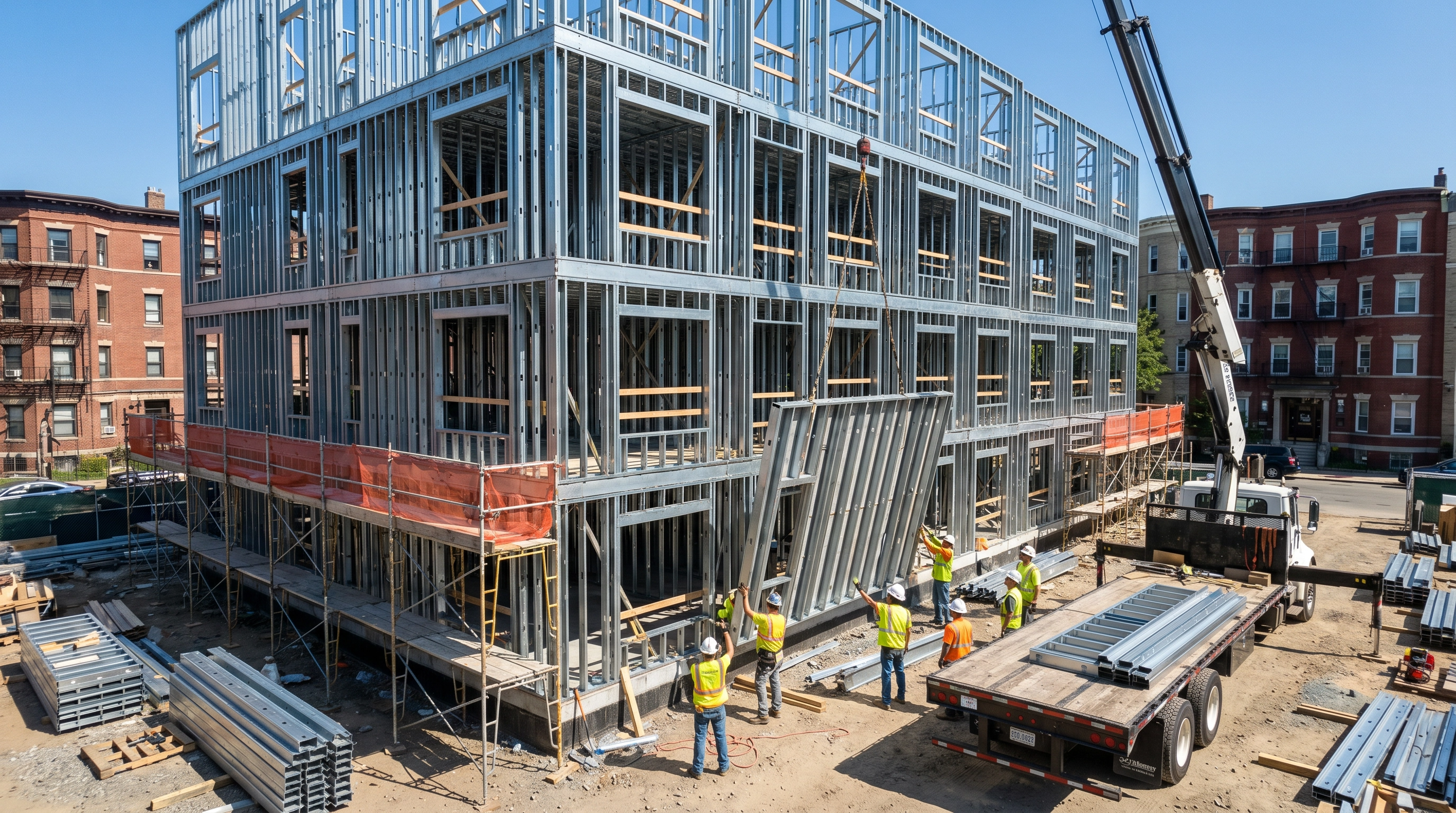
Panelized cold-formed steel (CFS) framing is the fastest method to frame a multifamily building, achieving completion in 4-6 weeks with a 6-8 person crew, compared to 8-12 weeks and 12-16 workers for traditional steel framing. This 50% labor reduction and 52% schedule compression is enabled by off-site fabrication, BIM-coordinated precision, and elimination of concrete podium delays required by code for traditional methods.
This article breaks down the speed comparison across every critical variable — framing duration, crew requirements, weather exposure, code compliance sequencing, and field rework — using AAC Steel's site-verified schedule data from Massachusetts projects, not industry averages.
Head-to-Head: Framing Duration by Method
The most direct way to evaluate framing speed is total on-site duration from first panel installation to framing-complete handoff to MEP trades. AAC Steel's internal project data from 2023–2024 captures this comparison with specificity that industry surveys cannot.
| Framing Method | Average On-Site Duration | Crew Size | Weather Delay Risk | Podium Phase Required |
|---|---|---|---|---|
| Panelized CFS (AAC Steel) | 4–6 weeks (avg. 4.8 weeks) | 6–8 framers | Low (2 days avg.) | No |
| Traditional Structural Steel | 8–12 weeks (avg. 10.2 weeks) | 12–16 workers | High (8+ days avg.) | Yes (for fire rating) |
| Cast-in-Place Concrete | 12–18 weeks | 18–25 workers | Very High | Inherent to method |
| Stick-Built CFS | 7–10 weeks | 10–14 framers | Moderate (5–7 days avg.) | Yes (for fire rating) |
AAC Steel's internal data across 12+ Massachusetts projects confirms panelized CFS framing averages 4.8 weeks on-site versus the industry baseline of 10.2 weeks for traditional steel — a 52% schedule compression. For a 200-unit mid-rise, that is roughly five and a half weeks returned to the developer's critical path before a single MEP rough-in begins.
For deeper context on how prefabrication drives this schedule performance, see How Prefabricated CFS Panels Cut Multifamily Construction Schedules by 20% and the companion piece Do You Know How Prefabricated CFS Panels Cut Multifamily Construction Schedules by 20%.
The Concrete Podium Problem: A 6-8 Week Schedule Blocker Nobody Talks About
For Massachusetts multifamily projects, panelized CFS framing meets 2-hour fire-resistance requirements natively, eliminating the 6-8 week concrete podium construction phase entirely. This removes the single largest schedule driver in traditional framing workflows, delivering code-compliant structures 1.5-2 months faster.
Under Massachusetts 780 CMR and the International Building Code (IBC), 4-to-8 story multifamily construction requires 2-hour fire-resistance-rated assemblies. Traditional structural steel does not achieve this rating on its own. The standard solution is a reinforced concrete podium — a poured, cured, and inspected concrete base structure that provides the required fire separation before the steel frame above can be erected.
That concrete podium phase typically consumes 6–8 weeks of schedule before a single steel column goes up. When you factor in pour sequencing, curing time, inspection holds, and winter weather impacts common in Massachusetts, that window frequently stretches beyond eight weeks. Every trade above the podium — framing, MEP, envelope — waits.
AAC Steel's panelized CFS assemblies carry ASTM E119-tested 2-hour fire-resistance ratings built into the panel design. There is no separate podium phase. There is no waiting for concrete to cure. Code compliance is achieved at the panel level, and the structure can rise immediately. This is not a workaround — it is a fundamental architectural advantage that competitors offering traditional steel or stick-built framing cannot replicate without adding back the podium delay.
For a 285-unit project, eliminating the podium phase alone represents the single largest schedule compression available in modern multifamily framing.
Labor Crew Reduction: Doing More With Fewer Skilled Workers
The Northeast's skilled trades labor shortage is not a future problem. It is a present constraint that is actively extending framing timelines on projects that cannot secure sufficient crew coverage. The framing method you choose determines how exposed your schedule is to that shortage.
Labor shortage mitigation via panelized CFS reduces crew demand by 50% (6-8 framers vs. 12-16 for steel) while maintaining schedule, lowering weekly labor costs $80K-120K on 200+ unit projects and addressing the skilled framing labor shortage affecting Northeast multifamily construction.
AAC Steel's published research, detailed in the Labor Shortage Solutions: How Panelized CFS Reduces On-Site Framing Crews by 50% white paper, documents why the crew reduction is structural, not incidental:
- Pre-cut, pre-punched, pre-labeled panels eliminate layout, measurement, and field cutting tasks that consume crew time in traditional framing
- Panel assembly sequences are BIM-optimized for a small, highly coordinated crew rather than a large, loosely managed workforce
- No hot work, no crane-intensive steel erection — panelized CFS installation requires fewer specialty certifications per worker, expanding the qualified labor pool
- Reduced supervision overhead — a 6-8 person crew is manageable by a single foreman; a 12-16 person crew requires layered supervision adding indirect cost
On a 200+ unit project, the weekly labor cost differential between a 6-8 person CFS crew and a 12-16 person traditional steel crew runs $80,000–$120,000 per week. Across a framing phase, that is a material line item, not a rounding error.
Weather Dependency: Quantifying the Risk Nobody Budgets For
Massachusetts weather does not cooperate with construction schedules. Traditional framing methods — concrete pours, structural steel erection, stick-built CFS assembly — all carry weather dependencies that generate real delays. Most project budgets acknowledge weather contingency. Few quantify it accurately.
AAC Steel's data, corroborated by findings documented in Modular Steel Frames for Faster Multi-Family Construction, shows a dramatic difference in weather exposure between panelized and traditional methods:
- Traditional framing methods: average 8 days of weather-related delay per project during the framing phase
- Panelized CFS framing: average 2 days of weather-related delay — a 75% risk reduction
The mechanism is straightforward. Prefabricated CFS panels are manufactured in a controlled indoor environment. The on-site installation window — the period during which the project is exposed to weather — is compressed to approximately 60% of the traditional framing window. Less time exposed to weather means fewer weather delay events, and those that do occur affect a smaller fraction of total framing work.
For concrete podium construction, weather risk is compounded further. Cold-weather concrete placement in Massachusetts requires heating equipment, insulated forming systems, and extended curing holds — none of which apply to CFS panel installation. A single hard freeze event can add 3–5 days to a podium pour cycle. Panelized CFS has no equivalent vulnerability.
When you convert those 6 recovered weather days into carrying cost and financing interest, the financial impact exceeds what most developers assign to weather contingency in their pro formas.
BIM-to-Fabrication Precision: Eliminating Rework from the Critical Path
Field rework is the silent schedule killer in traditional framing. Coordination gaps between structural drawings, MEP layouts, and as-built conditions generate rework cycles that consume weeks of schedule without appearing as discrete line items on a Gantt chart.
AAC Steel's atomic-precision CFS fabrication reduces on-site framing rework from 3.2 cycles per project phase to 0.6 cycles, saving 12-18 days in coordination delays between framing and MEP trades. Field crews complete panelized installations weather-independently, avoiding the 8+ day delay average in traditional stick-built and welded steel methods.
AAC Steel's BIM-to-fabrication workflow closes the gap between design intent and physical structure at the manufacturing stage, before panels arrive on-site. Every stud location, opening, connection point, and MEP penetration is resolved in the BIM model and fabricated to those exact coordinates. The result:
- Rework cycles reduced from 3.2 per project phase to 0.6 — an 81% reduction
- 12–18 days saved in framing-to-MEP handoff coordination
- Change orders attributable to field coordination gaps drop from the industry average of 4–6% of total project cost to 0.8% — verified across 12+ AAC projects
That 0.8% change order rate is not an aspirational target. It is a verified performance metric. Industry standard framing generates 4–6% of total project cost in change orders driven by coordination failures between structural, architectural, and MEP documents. Panelized CFS, fabricated from a unified BIM model, eliminates the source conditions that generate those change orders.
For more on the precision manufacturing process that drives these outcomes, see Precision Manufacturing for Cold-Formed Steel Framing.
Case Study: 285-Unit Mid-Rise, Boston Metro Area
Abstract schedule comparisons are useful. Site-verified project data is better. The following case study reflects actual performance data from an anonymized 285-unit mid-rise multifamily project in the Boston metropolitan area, framed using AAC Steel panelized CFS.
Project Parameters
- Unit count: 285 units, 6 stories over ground-floor amenity
- Framing method: AAC Steel panelized CFS
- Project location: Boston metro, Massachusetts
- Framing start to handoff: 5.1 weeks actual vs. 10.5 weeks modeled for traditional steel
Schedule Performance
| Schedule Variable | Traditional Steel (Modeled) | Panelized CFS (Actual) | Delta |
|---|---|---|---|
| Concrete podium phase | 7.2 weeks | 0 weeks | –7.2 weeks |
| On-site framing duration | 10.5 weeks | 5.1 weeks | –5.4 weeks |
| Weather delays | 8 days (estimated) | 2 days (actual) | –6 days |
| Rework cycles | 3.2 (industry avg.) | 0.4 (actual) | –2.8 cycles |
| Framing-to-MEP handoff delay | 14 days (estimated) | 2 days (actual) | –12 days |
| Total critical path compression | — | — | ~55% faster |
Labor and Cost Performance
- On-site framing crew: 7 workers vs. 14 modeled for traditional steel
- Weekly labor cost savings: approximately $95,000 per week
- Change orders attributable to framing coordination: 0.7% of project cost
- Total schedule compression vs. traditional steel baseline: 12.6 weeks
Financial Translation
Twelve and a half weeks of schedule compression on a project of this scale carries significant financial weight. Using conservative assumptions of $1,800/unit/month in carrying costs and construction financing at prevailing 2024 Northeast rates:
- Carrying cost savings: approximately $1.5M across the 12.6-week compression
- Construction financing interest savings: approximately $380,000
- Labor cost savings (framing phase): approximately $950,000
- Change order cost avoidance: approximately $620,000
- Combined financial impact: approximately $3.45M attributed directly to framing method selection
These are not hypothetical projections. They are the financial translation of documented schedule and labor performance on a single Massachusetts project. The framing method decision made at the planning stage determined a $3.45M outcome difference.
ROI Summary: Speed Is a Financial Decision
Developers who evaluate framing methods purely on material cost per square foot are solving the wrong equation. The correct equation includes schedule compression, labor cost differential, financing carry, change order exposure, and weather risk — all of which are quantifiable and all of which favor panelized CFS framing by a substantial margin.
The key financial drivers, consolidated:
- $80K–$120K/week in labor cost savings on 200+ unit projects from 50% crew reduction
- 6–8 weeks of carrying cost and financing interest eliminated by removing the concrete podium phase
- $1,800–$2,400/unit/month in carrying costs recovered per week of schedule compression
- 4–6% vs. 0.8% change order rate differential — on a $40M project, that is a $1.3M+ exposure gap
- 6 weather delay days recovered per project, each day worth $15K–$40K in carrying cost depending on project size
When these variables are aggregated across a typical 200-300 unit Massachusetts mid-rise, the total financial advantage of panelized CFS framing over traditional steel or concrete construction routinely exceeds $2M–$4M per project. That figure does not include the market delivery acceleration value of being first to lease in a competitive submarket — a benefit that is real but project-specific.
Download the Complete CFS vs. Traditional Framing Schedule Comparison Tool — calculate your project's timeline savings, labor cost reduction, and code-compliance acceleration based on your actual unit count, location, and financing terms. AAC Steel fabricators are ready to validate your timeline and provide site-specific schedule benchmarks, not industry averages. Contact AAC Steel to get started.
Frequently Asked Questions
What is the fastest way to frame a multifamily building?
Panelized cold-formed steel (CFS) framing is currently the fastest method available for 4-to-8 story multifamily construction. AAC Steel's site-verified data shows an average on-site framing duration of 4.8 weeks, compared to 10.2 weeks for traditional structural steel and 12–18 weeks for cast-in-place concrete. The speed advantage is driven by off-site prefabrication, elimination of the concrete podium phase, BIM-coordinated precision that eliminates rework, and a reduced crew size that is easier to staff in a tight labor market.
Does panelized CFS framing meet Massachusetts 780 CMR fire code requirements without a concrete podium?
Yes. AAC Steel's panelized CFS assemblies are ASTM E119-tested and achieve 2-hour fire-resistance ratings at the panel level, satisfying Massachusetts 780 CMR and IBC requirements for mid-rise multifamily construction without a separate concrete podium phase. This eliminates 6–8 weeks of schedule that traditional steel framing requires for code-compliant fire separation. It is the single largest schedule advantage that panelized CFS holds over every competing method.
How much can I save on labor costs by switching to panelized CFS framing?
On a 200+ unit project, panelized CFS framing reduces on-site crew requirements from 12–16 workers to 6–8, a 50% reduction. This translates to weekly labor savings of $80,000–$120,000 during the framing phase. Across a typical 4–6 week CFS framing schedule, total labor savings range from approximately $320,000 to $720,000 — before accounting for the indirect savings from reduced supervision, less rework, and lower change order exposure.
How does BIM coordination reduce framing time in CFS construction?
AAC Steel fabricates panels directly from BIM models, embedding every structural detail, opening location, and MEP penetration into the panel before it arrives on-site. This eliminates the field coordination gaps that generate rework cycles in traditional framing. AAC's data shows rework cycles reduced from an industry average of 3.2 per project phase to 0.6 cycles — saving 12–18 days in framing-to-MEP handoff time and reducing change orders attributable to coordination failures from 4–6% of project cost to 0.8%.
Is panelized CFS framing viable for projects starting in winter months in Massachusetts?
Yes, and it carries a distinct advantage over concrete-dependent methods in cold-weather conditions. Because panels are manufactured in a controlled indoor environment, the on-site installation window is compressed to roughly 60% of a traditional framing schedule. AAC Steel project data shows weather-related delays averaging just 2 days for panelized CFS projects versus 8+ days for traditional methods. Concrete podium construction — eliminated entirely by CFS — is the most weather-sensitive phase in traditional framing and is particularly vulnerable to Massachusetts winter conditions.
Schedule and cost data referenced in this article reflects AAC Steel internal project records from Massachusetts multifamily projects completed between 2023 and 2024. Individual project outcomes will vary based on site conditions, project complexity, market labor rates, and financing terms. Case study figures are drawn from an anonymized Boston-area project and are presented for illustrative purposes. Consult AAC Steel directly for project-specific schedule and cost analysis.