CFS vs. Wood Framing: True Cost per Square Foot in Multifamily Construction
By Carlos Ferreira · April 7, 2026
CFS vs. Wood Framing: True Cost per Square Foot in Multifamily Construction
Why cold-formed steel (CFS) delivers lower lifecycle cost — even when the sticker price looks higher
Published by AAC Steel | aacsteel.com | Franklin, MA
The Framing-Cost Paradox: Why Per-SF Comparisons Mislead
Ask any estimator for a quick number and you will hear the same refrain: wood studs are cheaper. On a raw framing-material basis, that is correct. RSMeans 2024 data shows wood framing at $8–12/SF versus cold-formed steel (CFS) framing at $12–16/SF. But stopping the analysis at material price per square foot is like judging a building’s energy cost by the price of the thermostat.
The real question is total installed project cost — and that is where the math reverses. When AAC Steel’s engineering team runs full-scope estimates for multifamily developers in Massachusetts and across New England, CFS routinely comes in 24% less expensive than wood at elevated lumber prices (SFIA 2023 Market Report). The explanation lies in structural system effects that never show up on a single line item.
Podium Elimination: The $730K+ Per-Floor Advantage
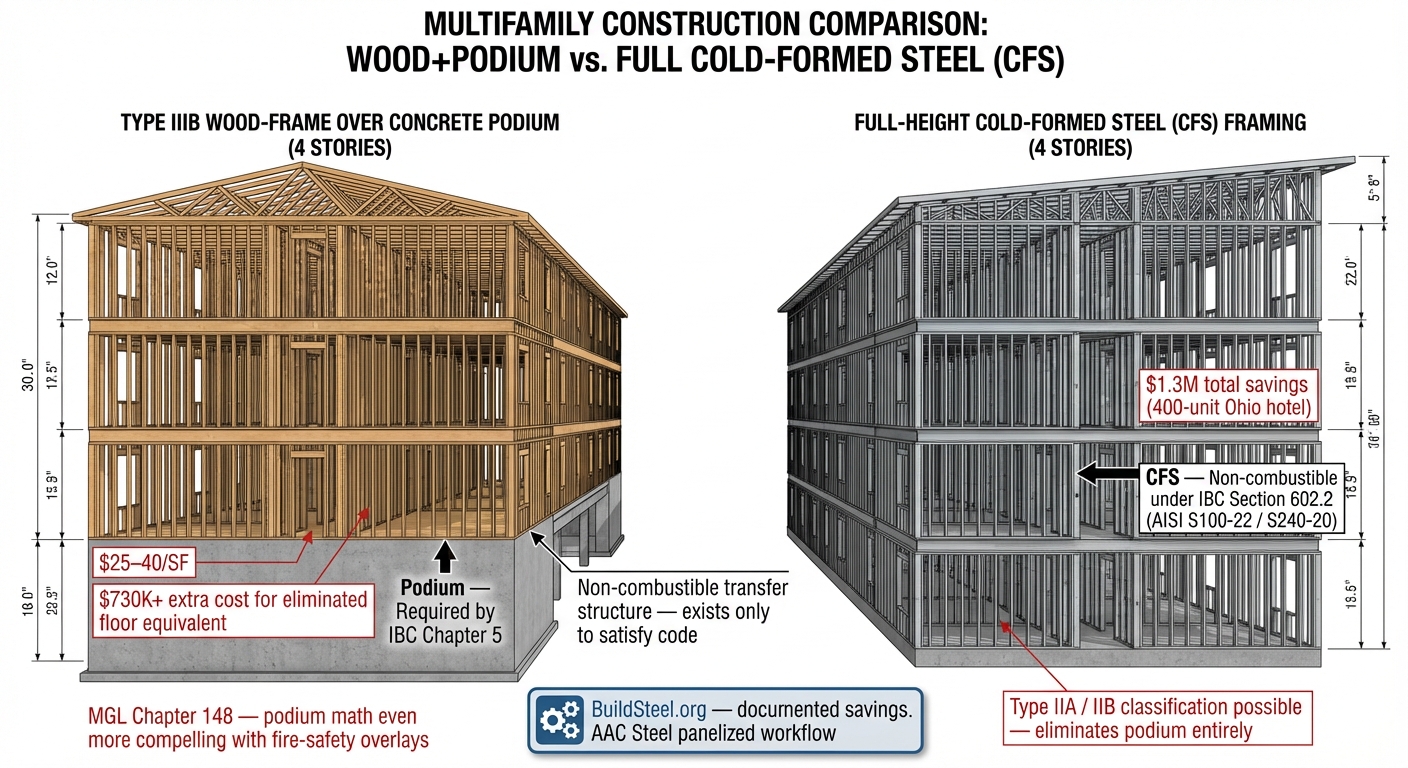
Under IBC Chapter 5, Type IIIB wood-frame construction above three stories requires a concrete podium — a non-combustible transfer structure that adds $25–40/SF per podium level (RSMeans 2024). A typical 4-story, 200-unit multifamily project built as Type IIIA wood-over-podium carries at least one full concrete level that exists purely to satisfy code.
Cold-formed steel (CFS) framing, designed to AISI S100-22 and AISI S240-20, qualifies as non-combustible under IBC Section 602.2. That classification lets AAC Steel-fabricated panelized walls go from foundation to roof without a podium break — saving $730K+ per eliminated floor (BuildSteel.org Case Study Library). On a 4-story Ohio hotel project with 400 units, the developer documented $1.3M in total savings by switching from wood podium to full-height CFS panels fabricated by a partner facility using the same panelization workflow AAC Steel employs.
For Massachusetts developers facing MGL Chapter 148 fire-safety overlays on top of IBC, the podium math is even more compelling. AAC Steel regularly designs CFS framing packages that achieve Type IIA or Type IIB classification, eliminating podium requirements entirely.
Material Price Volatility: CFS Stability vs. Lumber Swings
Between 2020 and 2023, softwood lumber experienced 300% price swings — from roughly $350/MBF to over $1,700/MBF and back again (Random Lengths, CME Futures Data). Those swings are not academic; they blow up pro formas mid-entitlement and force developers to re-bid after permit.
CFS pricing, tied to flat-rolled steel coil, has historically moved in a narrower band. More importantly, steel is recyclable, globally traded, and sourced from multiple domestic mills — giving fabricators like AAC Steel the ability to lock pricing 90–120 days out with mill-direct contracts. That budget certainty has measurable value: developers who switch to CFS report fewer change orders and tighter contingency draws (SFIA Member Survey 2023).
Insurance and Risk: 38% Savings Over 30 Years
Builder’s risk insurance premiums reveal how underwriters actually price combustibility. CFS-framed projects carry builder’s risk rates of 1–1.1 cents per $100 insured per month. Wood-framed projects: 5–6 cents per $100 per month (SFIA Insurance Benchmark Report). That is a 4–5x premium differential during the construction phase alone.
Over a 30-year hold period, CFS-framed multifamily buildings deliver 38% average insurance savings compared to wood-frame equivalents when factoring builder’s risk, property, and liability coverage (BuildSteel.org Lifecycle Cost Analysis). For a 200-unit asset valued at $40M, that translates to hundreds of thousands in cumulative savings — capital that AAC Steel’s clients redirect to finishes, amenities, and NOI improvement.
Code Compliance and Fire Rating: CFS Advantages
CFS framing achieves non-combustible classification under IBC Section 602.2 without chemical treatment. Wood framing requires fire-retardant treatment (FRT) for Type IIIA, adding $1.50–3.00/SF and introducing long-term concerns about FRT chemical degradation documented in AWPA standards.
UL-listed CFS wall assemblies (e.g., UL U425, U431) achieve 1-hour and 2-hour fire ratings with standard gypsum layers. AAC Steel’s panelized CFS walls arrive on site pre-engineered to these UL designs, ensuring consistent fire-rated assembly quality that field-framed wood cannot match. Wind and seismic loads are addressed per ASCE 7-22, with CFS shear walls designed to AISI S400-20 providing ductile lateral resistance.
Schedule Compression: Panelized CFS vs. Stick-Frame Wood
AAC Steel’s panelized CFS framing is fabricated off-site with CNC precision. Panels arrive labeled, sequenced, and ready for erection — eliminating the skilled-carpentry bottleneck that slows wood stick-framing in today’s labor market.
Field data from CFS panelizers shows 20–30% schedule compression versus stick-frame wood (SFIA Speed-to-Market Report). On a 150-unit project, that can mean 8–12 weeks of saved carrying cost on construction loans. At current interest rates, every month saved is worth $15K–$25K per $10M in project value. AAC Steel’s Franklin, MA facility serves projects across New England, with typical lead times of 4–6 weeks from approved shop drawings to panel delivery.
Per-SF Cost Comparison: CFS vs. Wood Framing (4-Story, 200-Unit Multifamily)
| Cost Category | Wood Frame (Type IIIA/IIIB) | CFS Frame (Type IIA/IIB) | Delta |
|---|---|---|---|
| Framing material ($/SF) | $8–12 | $12–16 | +$4 CFS |
| Podium structure ($/SF) | $25–40 (1 level required) | $0 (not required) | –$25–40 savings |
| Fire-retardant treatment | $1.50–3.00/SF | $0 (inherently non-combustible) | –$1.50–3.00 savings |
| Builder’s risk insurance | 5–6 cents/$100/mo | 1–1.1 cents/$100/mo | ~80% lower |
| Schedule (months) | 14–18 | 10–14 | 2–4 months faster |
| Material price volatility | 300% swings (2020–2023) | Narrow band, lockable | Lower risk premium |
Lifecycle Cost Impact: 30-Year Hold Period
| Metric | Wood Frame | CFS Frame | Source |
|---|---|---|---|
| Insurance savings (cumulative) | Baseline | 38% lower | BuildSteel.org |
| Podium cost avoidance (per floor) | N/A | $730K+ saved | BuildSteel.org |
| Total project savings (documented) | Baseline | $1.3M (400-unit hotel) | SFIA Case Study |
| Comparative cost at high lumber | Baseline | 24% less expensive | SFIA 2023 |
Frequently Asked Questions
Is CFS framing more expensive per square foot than wood?
On a raw framing-material basis, yes. RSMeans 2024 shows CFS at $12–16/SF vs. wood at $8–12/SF. But total project cost — including podium elimination, insurance, schedule savings, and FRT avoidance — typically makes CFS 24% less expensive at elevated lumber prices. AAC Steel provides full-scope estimates so developers can compare apples to apples.
Does CFS meet fire code for multifamily?
Yes. CFS is classified as non-combustible under IBC Section 602.2. UL-listed assemblies such as U425 and U431 achieve 1-hour and 2-hour fire ratings. AAC Steel’s panelized walls are pre-engineered to these UL designs.
What about sound transmission — is CFS noisier than wood?
CFS wall and floor assemblies achieve STC 50+ and IIC 50+ ratings when properly designed with resilient channel and acoustic insulation — meeting or exceeding IBC Section 1207 requirements. AAC Steel specifies assemblies that meet these thresholds as standard practice.
How does CFS handle moisture and mold?
Steel does not absorb moisture, swell, or support mold growth. In New England’s humid climate, this is a significant durability advantage over wood framing. AAC Steel uses G60/G90 galvanized steel per ASTM A653, providing corrosion resistance for the full service life of the structure.
Can AAC Steel handle my project?
AAC Steel, based in Franklin, MA, is a CFS panel fabricator serving multifamily developers across New England. From design-assist through panel delivery, AAC Steel provides engineering, fabrication, and project coordination. Visit aacsteel.com or call for a project consultation.
Where do the cost figures come from?
All cost data in this article references RSMeans 2024, SFIA (Steel Framing Industry Association) reports, and BuildSteel.org case studies. Lumber volatility data references Random Lengths and CME Futures pricing from 2020–2023. Insurance benchmarks reference SFIA member surveys.
Get a CFS Cost Comparison for Your Next Project
AAC Steel provides free design-assist estimates for multifamily developers evaluating cold-formed steel (CFS) framing. Our Franklin, MA facility serves projects across New England with panelized CFS wall systems engineered to IBC, AISI, and ASCE 7-22 standards. Contact AAC Steel at aacsteel.com to request a project consultation.